
Your water heater just failed, maybe it’s leaking across the garage floor, maybe you woke up to ice-cold water, or maybe you heard a loud pop that didn’t sound right. Whatever happened, you need an emergency water heater replacement fast, and you’re probably wondering what steps to take right now. The good news: you don’t have to figure this out alone.
At Bizzy B Plumbing, we handle these exact calls from homeowners across Knoxville, Alcoa, Maryville, and the surrounding East Tennessee area. As a veteran-owned, local plumbing company, we know that a dead water heater isn’t something that can wait until next week, which is why we offer same-day service to get your hot water back as quickly as possible.
This guide walks you through what to do the moment your water heater fails, how to stay safe, what replacement options are available, and how to choose the right plumber for the job. We’ll cover costs you should expect, warning signs you shouldn’t ignore, and the questions worth asking before anyone starts work. Whether you’re dealing with a crisis right now or trying to prepare before one hits, this article has you covered.
When a water heater problem is an emergency
Not every water heater issue demands an immediate call to a plumber, but some absolutely do. Knowing the difference saves you time, protects your home from serious damage, and in certain cases, keeps your family safe. A standard complaint like mildly warm water might point to a failing heating element, which is a straightforward repair. But specific warning signs mean you’re dealing with a genuine emergency, one where waiting even a few hours can make things significantly worse and significantly more expensive.
Signs you need to act immediately
Certain water heater problems cross from “inconvenient” to “dangerous” fast. If you see water actively pooling on the floor around the unit, your first concern is water damage to flooring, drywall, and anything stored nearby. A spreading leak can also signal a failing pressure relief valve or a cracked tank, both of which can escalate without warning. If you smell rotten eggs or a strong sulfur odor near a gas water heater, that’s a potential gas leak. Stop using any appliances, leave the house, and call your gas utility provider immediately before contacting a plumber.
If you smell gas near your water heater, don’t turn any lights on or off, don’t use your phone inside the house, and get outside before making any calls.
Other signs that put you in emergency water heater replacement territory include:
- Loud rumbling, popping, or banging from the tank (often caused by dangerous sediment buildup or internal pressure problems)
- Rust-colored or discolored hot water at your taps, which can indicate the tank is corroding from the inside
- No hot water at all combined with visible damage to the unit or surrounding area
- A pressure relief valve actively releasing water or steam rather than sitting closed
Any one of these situations calls for immediate action, not a wait-and-see approach.
Problems that can wait a short time
Slightly cooler water than usual might point to a thermostat setting or a single failed heating element, both of which are repairs that can typically be scheduled within a day or two without causing further harm. Minor dripping from a pipe fitting or connection rather than the tank itself is worth monitoring and getting evaluated soon, but it won’t cause immediate structural damage in most cases.
The key distinction is where the water is coming from and how fast it’s spreading. A slow drip from a fitting is a different problem than water moving across the floor. A brief stretch of lukewarm water is different from a complete loss of hot water paired with a hissing sound from the unit. Pay attention to the combination of symptoms, not just one in isolation.
Why waiting too long costs you more
Putting off an urgent water heater problem almost always increases your total bill. Water damage from a leaking tank can affect subfloors, adjacent walls, and insulation, turning a plumbing repair into a much larger and more costly restoration project. Most homeowners underestimate how quickly water travels once a tank starts going.
Beyond the physical damage, a failed water heater disrupts your routine in ways that add up fast, from cold showers to an unusable dishwasher or washing machine. Calling a plumber at the first serious warning sign, rather than hoping the problem resolves on its own, gives you more options and typically lower overall costs in nearly every situation.
Step 1. Make the situation safe right now
Before you call anyone or think about your options, your first job is to stop the situation from getting worse. Water heater failures can involve flooding, gas leaks, or electrical hazards, and each one requires a specific response. Taking two to three minutes to handle these steps correctly protects you, your family, and your home while you wait for a plumber to arrive.
Shut off the water supply
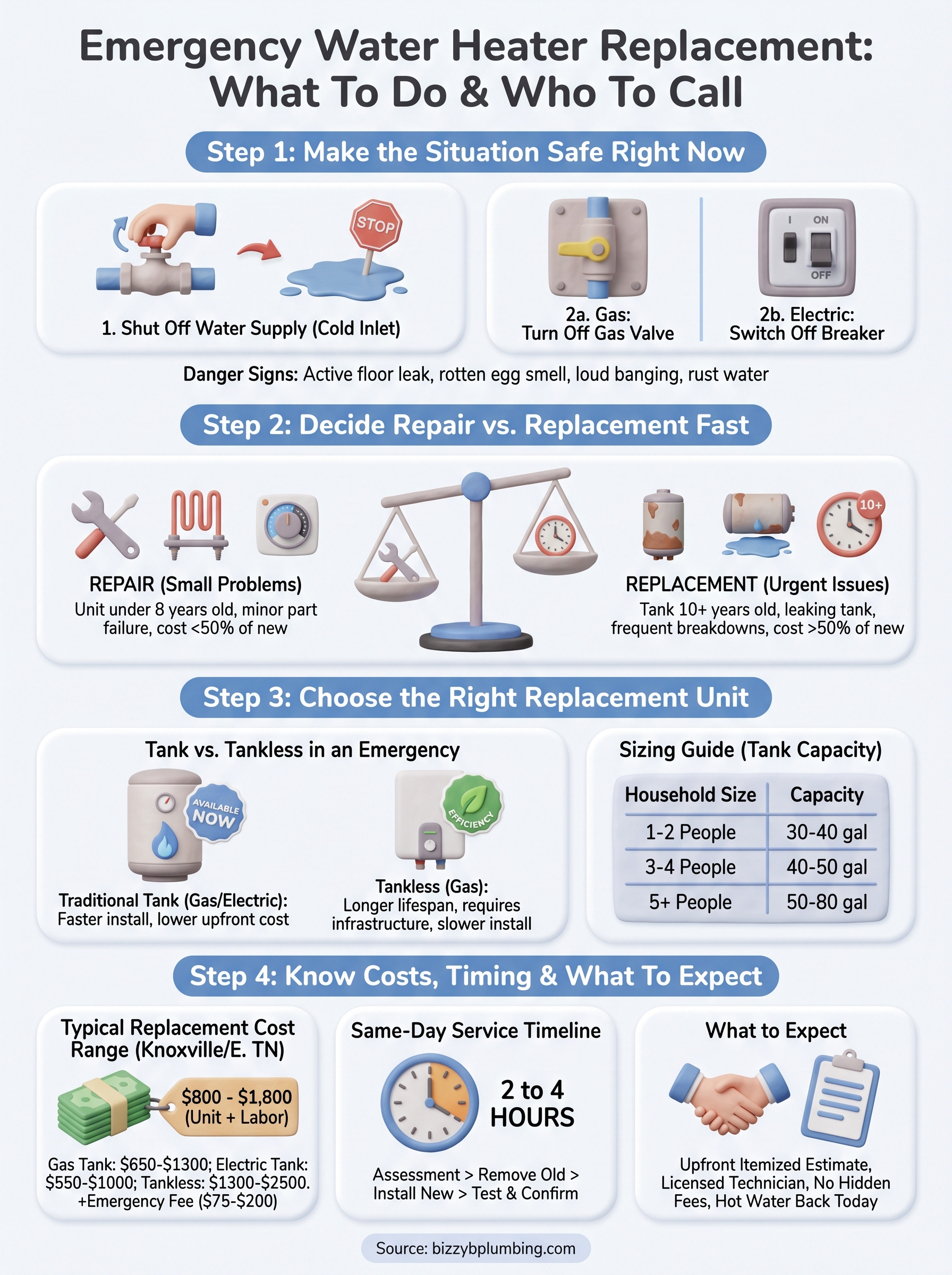
The cold water supply valve sits on the pipe running into the top of your water heater. Turn it clockwise until it stops moving completely. If the valve is stuck or you can’t locate it, find your home’s main water shutoff instead, typically near the water meter, in a utility room, or in a basement. Shutting off water at the source stops the leak from continuing to grow.
If water is spreading across the floor, grab towels or a wet/dry vacuum to start containing it while you work on the shutoff.
After stopping the flow, turn off the cold water inlet valve on any nearby appliances connected to that same line if you have trouble isolating the tank itself.
Handle the gas or electrical connection
For gas water heaters, locate the gas shutoff valve on the supply line running to the unit. It’s usually a lever or knob within a foot of the heater. Turn it so the lever sits perpendicular to the pipe, which closes the valve. If you smell gas strongly or suspect a leak at the line itself, don’t attempt to close the valve yourself. Leave the house immediately and call your gas utility provider from outside before doing anything else.
Electric water heaters require a different step. Go to your breaker panel and switch off the dedicated breaker labeled for the water heater. Most electric units run on a 240-volt double-pole breaker, and it needs to be in the off position before anyone touches the unit. Water and live electricity create serious risk, so don’t skip this even if the unit appears to have already stopped working.
Once the water is off and the energy source is shut down, your situation is stable. Now you can safely assess the damage and call a plumber to discuss emergency water heater replacement options without the problem actively getting worse while you wait.
Step 2. Decide repair vs replacement fast
Once the situation is under control, you need to make a decision: repair the existing unit or move forward with an emergency water heater replacement. Making the wrong call costs you money either way, so it helps to think through the key factors before a plumber even arrives. Age, type of failure, and the cost of parts all play a role in what makes financial sense for your specific situation.
Signs that point to repair
Some water heater problems are straightforward fixes that don’t require replacing the whole unit. A failed heating element on an electric unit is one of the most common examples, and replacing it typically costs between $150 and $300 including labor. A faulty thermostat, a bad pilot light assembly, or a worn-out anode rod all fall into the same category: specific components fail, and swapping them out restores function without touching the tank itself.
If your unit is under 8 years old and the tank shows no signs of corrosion or cracking, a targeted repair is usually the right call. Ask the plumber to confirm that no other components are showing early signs of wear before agreeing to the repair, since fixing one part on an aging unit sometimes just shifts the failure to the next weakest component within months.
Signs that point to replacement
Replacement becomes the smarter choice in several clear situations, and recognizing them early saves you from spending money on a repair that won’t hold. The single most reliable factor is tank age combined with the nature of the failure. Use this quick checklist to assess where you stand:
- Tank is 10 or more years old: Most traditional water heaters last 8 to 12 years, and repeated repairs on an older unit rarely hold up financially.
- The tank itself is leaking: A cracked or corroded tank cannot be patched. Replacement is the only real fix.
- Repair cost exceeds 50% of a new unit’s price: A new 40-gallon tank runs $500 to $1,000 installed, so repairs pushing past that threshold rarely make sense.
- Multiple components have failed recently: Repeated breakdowns signal the unit is near the end of its service life.
If a plumber recommends a repair on a unit that’s 10 or more years old, ask directly whether replacement would be more cost-effective long-term before agreeing to any work.
Step 3. Choose the right replacement unit
Once you know replacement is the right call, picking the correct unit keeps you from creating a new problem while solving the current one. In an emergency water heater replacement situation, you’re balancing speed with the right fit for your home. A plumber can walk you through options on the spot, but going into that conversation with basic knowledge helps you make a confident decision rather than defaulting to whatever happens to be in stock.
Tank vs. tankless: what makes sense in an emergency
Traditional tank water heaters are the most common choice during emergency replacements, and for good reason. They’re widely available, faster to install, and less expensive upfront. A standard 40- or 50-gallon tank unit can typically be installed the same day, which matters when you’ve had no hot water since early morning.
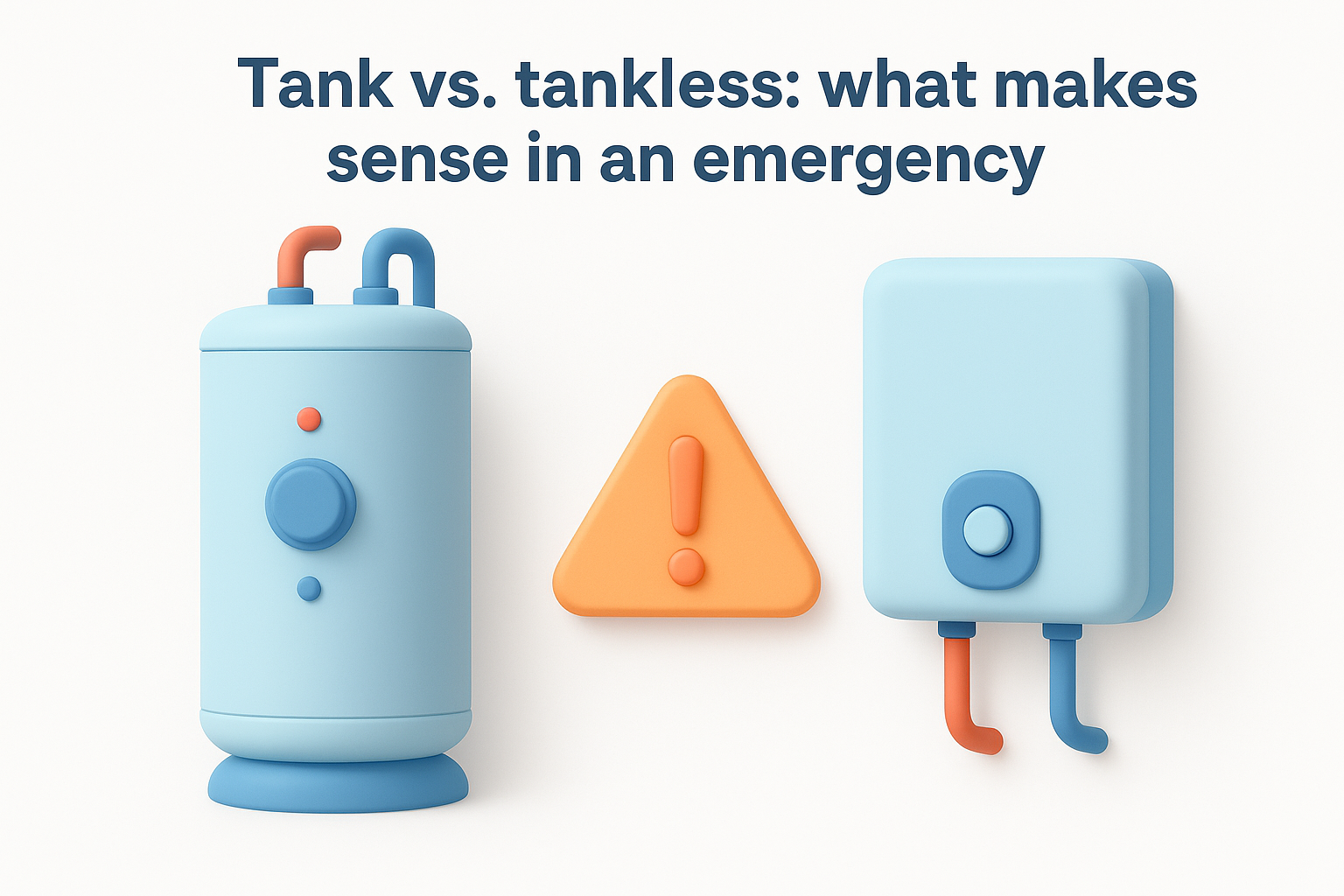
Tankless units often require upgrades to gas lines or electrical panels, which can push same-day installation out of reach during a genuine emergency.
Tankless water heaters heat water on demand and last longer on average, roughly 15 to 20 years compared to 10 to 12 for tank units, but they carry higher upfront costs and more complex installation requirements. If your home already has the right infrastructure and you want the long-term efficiency gains, tankless is worth discussing with your plumber. In most emergency situations, though, a tank unit gets your hot water back the fastest.
Match the unit to your home’s needs
Choosing the right capacity is the most practical call you’ll make in this process. A unit that’s too small leaves you running out of hot water mid-shower. One that’s too large wastes energy and costs more to operate every month. Use this sizing guide as a starting point before your plumber arrives:
| Household Size | Recommended Tank Capacity |
|---|---|
| 1 to 2 people | 30 to 40 gallons |
| 3 to 4 people | 40 to 50 gallons |
| 5 or more people | 50 to 80 gallons |
Fuel type should match what’s already running in your home. Switching from gas to electric, or the other direction, during an emergency adds cost and installation time that most homeowners can’t absorb on a short timeline. Stick with the same fuel source as your previous unit unless your plumber identifies a specific reason to change.
Step 4. Know costs, timing, and what to expect
Going into an emergency water heater replacement with a realistic picture of costs and timing gives you a meaningful advantage. You’re less likely to overpay, less likely to get caught off guard, and better positioned to make fast decisions when a plumber is standing in front of you explaining your options.
What you’ll pay for a replacement
Total replacement cost depends on the unit type, tank size, fuel source, and the complexity of the installation. In most cases, homeowners in the Knoxville and East Tennessee area pay between $800 and $1,800 for a full emergency replacement, including the unit and labor. That range covers the majority of standard tank replacements on existing infrastructure without major modifications.
Get an itemized estimate before work begins so you can see exactly what you’re paying for, including the unit cost, labor, and parts like connectors or expansion tanks.
Here’s a general cost breakdown by unit type:
| Unit Type | Unit Cost | Labor | Typical Total |
|---|---|---|---|
| 40-gallon gas tank | $400 to $650 | $250 to $450 | $650 to $1,100 |
| 50-gallon gas tank | $500 to $800 | $250 to $500 | $750 to $1,300 |
| 40-gallon electric tank | $350 to $600 | $200 to $400 | $550 to $1,000 |
| Tankless gas unit | $800 to $1,500 | $500 to $1,000 | $1,300 to $2,500 |
Emergency service fees can add $75 to $200 on top of these figures depending on the time of day and the plumbing company’s pricing structure. Always ask upfront whether an after-hours surcharge applies before you confirm the appointment.
What same-day service actually looks like
Most same-day replacements take between two and four hours from the time the plumber arrives to the point where you have hot water running again. That window includes removing the old unit, installing the new one, connecting all supply and discharge lines, testing for leaks, and confirming proper operation before anyone leaves.
Your plumber will also need 10 to 15 minutes at the start to assess the existing setup, verify the unit size, and walk you through the final estimate. Plan for downtime during installation since water to the heater stays off throughout the process. Clearing the area around your current unit before the plumber arrives speeds things up noticeably.
Get hot water back safely
A failed water heater puts your household on hold fast, but the steps in this guide give you a clear path forward from the moment something goes wrong. You now know how to shut things down safely, weigh repair against replacement, pick the right unit, and understand what a fair price looks like before anyone shows up at your door.
When you need an emergency water heater replacement in Knoxville, Alcoa, Maryville, or anywhere across East Tennessee, Bizzy B Plumbing is ready to help the same day you call. No pressure tactics, no hidden fees — just straight answers, upfront pricing, and a licensed technician who gets the job done right. Flexible financing is available if an unexpected replacement strains your budget.
Don’t wait for a small problem to turn into a flooded utility room. Contact Bizzy B Plumbing today and get your hot water back fast.