
Weak water pressure turns a simple shower into an exercise in patience and makes filling a pot for dinner take twice as long. If you’re trying to figure out how to increase water pressure at home, the good news is that most causes are straightforward, and many of them are things you can fix yourself without calling a plumber.
Low pressure can come from a single fixture or affect your entire house. The cause might be as simple as a clogged aerator or as involved as a failing pressure regulator. Either way, pinpointing the source is the first step toward getting your water flowing the way it should. At Bizzy B Plumbing, we help homeowners across Knoxville and East Tennessee troubleshoot and resolve water pressure problems every week, so we know which fixes actually work and which ones waste your time.
This guide walks you through 10 DIY fixes ranked from easiest to most involved. We’ll cover what to check first, when a repair is safely in DIY territory, and when it makes sense to bring in a professional before a small issue turns into a bigger one.
Before you start: measure pressure and flow
Before you try any fixes, you need a baseline reading of your current water pressure. Jumping straight into adjustments without knowing your numbers is like trying to fix a car without knowing what’s wrong. Taking two quick measurements, one for pressure and one for flow rate, will tell you whether you have a real pressure problem, a flow restriction, or both, and that determines which fix will actually solve your issue.
What normal water pressure looks like
Residential water pressure in the US typically falls between 40 and 80 psi (pounds per square inch). The sweet spot for most homes is 60 psi. Below 40 psi, you’ll notice weak showers, slow-filling toilets, and appliances like dishwashers or washing machines that underperform. Above 80 psi, you’re putting unnecessary strain on your pipes, valves, and appliances, which shortens their lifespan significantly.
If your pressure sits above 80 psi, you don’t have a low-pressure problem. High pressure causes just as much damage as low pressure, and it needs attention before anything else.
Local water utilities in Knoxville and across East Tennessee are required to deliver water at a minimum pressure to your meter. Most utilities target 40-60 psi at the meter, but what happens between the meter and your faucet depends entirely on your home’s plumbing. That gap is where most residential pressure problems actually live.
How to measure your water pressure
You need a water pressure gauge to get an accurate reading. These screw onto any standard hose bib (outdoor spigot) and cost $10-$20 at most hardware stores. Here’s how to use one:
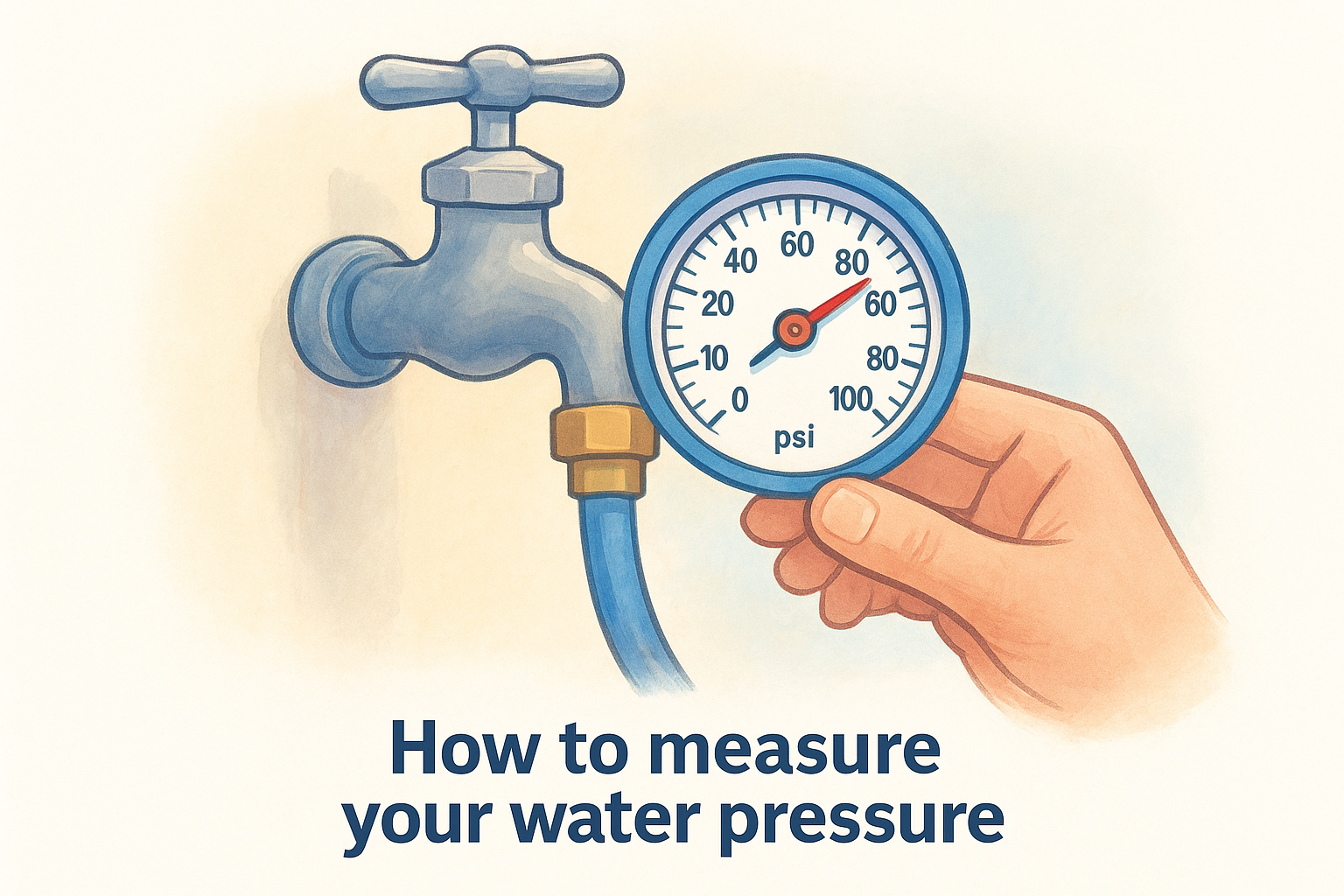
- Turn off all faucets and water-using appliances inside and outside the house.
- Screw the gauge onto an outdoor hose bib and hand-tighten it.
- Turn the hose bib fully open.
- Read the gauge and write down the number.
- Take a second reading first thing in the morning, since municipal pressure often drops during peak usage hours.
If you see a wide swing between your morning and afternoon readings, you may be dealing with variable municipal supply pressure rather than a problem inside your home. That’s useful information before you start pulling apart fixtures.
How to measure your flow rate
Flow rate tells you how many gallons per minute (GPM) come out of a fixture, and it tells a different story than pressure alone. A fixture can show decent pressure but have a blocked aerator or showerhead that severely restricts flow. Knowing both numbers before you tackle how to increase water pressure at home keeps you from fixing the wrong thing.
Measuring flow rate at any sink or tub takes about two minutes:
- Grab a one-gallon bucket and a stopwatch or phone timer.
- Turn the faucet to full cold.
- Time how long it takes to fill the bucket to the one-gallon mark.
- Divide 60 by the number of seconds. The result is your GPM.
For example, if the bucket fills in 20 seconds: 60 / 20 = 3 GPM. A kitchen faucet should deliver around 2.2 GPM, and a standard showerhead around 2.5 GPM. If your numbers fall well below these, you have a restriction problem on top of, or possibly instead of, a pressure problem.
Reading your results
Once you have both numbers, you can make a smarter call about where to start. Use this table as a quick reference:
| Pressure (psi) | Flow Rate | Likely Cause |
|---|---|---|
| Below 40 | Low at all fixtures | Whole-house pressure issue |
| 40-80 | Low at one fixture | Clogged aerator, showerhead, or supply line |
| 40-80 | Low throughout | Partially closed shutoff valve or PRV issue |
| Above 80 | Any | Pressure too high, needs a regulator |
Armed with both readings, you can skip fixes that don’t apply to your situation and go straight to what will actually make a difference in your home.
Step 1. Confirm where the pressure drops
Knowing your pressure and flow numbers is a good start, but those readings don’t tell you where in your home the problem actually lives. Before you can figure out how to increase water pressure at home, you need to isolate the drop to a specific zone or fixture. Doing this systematically saves you from replacing parts that aren’t causing the problem and zeroes in on the real fix faster.
Test each fixture individually
Start at the fixture where you first noticed the weak pressure, then work outward from there. Turn each faucet to full cold and note whether the pressure feels consistent, weak, or variable compared to other fixtures you’ve already tested. Do this at every sink, shower, and outdoor hose bib you can reach, and write your results down so you have a clear picture of where the drop starts and stops.
Use this checklist to track what you find:
- Kitchen sink (cold): pressure level, any visible aerator buildup
- Kitchen sink (hot): compare directly to cold to check water heater supply
- Bathroom sink(s): note which floor each one is on
- Shower(s): note whether pressure drops when another fixture runs at the same time
- Outdoor hose bib(s): useful for comparing directly to street supply pressure
- Washing machine supply valves: check both hot and cold sides independently
Look for a pattern in your results
Once you’ve tested every fixture, the pattern in your notes points directly to the most likely cause. A single weak fixture almost always means a local restriction, like a clogged aerator or a partially closed supply valve under that sink. Weak pressure across the whole house points further upstream, toward your main shutoff valve, pressure regulator, or the municipal supply line coming into your home.
If pressure drops sharply when two or more fixtures run simultaneously, your supply line diameter or a corroded pipe section is likely the culprit, not any individual fixture.
Hot water pressure that runs noticeably lower than cold is a separate signal worth paying close attention to. Sediment buildup inside the water heater tank or a failing supply valve on the heater can choke hot-side pressure across the entire house while leaving cold-side pressure completely normal. That distinction saves you from chasing the wrong fix entirely.
Pay attention to whether the pressure drop happens consistently on a specific floor. Upper floors naturally receive slightly less pressure than lower floors due to elevation. If your second-floor bathroom has weaker pressure than the ground floor but everything else checks out, that’s a physics issue rather than a plumbing fault, and it calls for a different solution than a clogged aerator would.
Step 2. 10 DIY fixes for better water pressure
Now that you know where your pressure drops, you can match the right fix to the right problem. The list below covers the most common DIY solutions for how to increase water pressure at home, ordered from the simplest tasks that take five minutes to the ones that require a bit more time and basic tools. Work through the ones that match your situation rather than trying all ten in sequence.
The 10 fixes, ranked easiest to most involved
Each fix below targets a specific cause. Read the description next to each one so you apply the right solution to the right problem instead of working through unrelated repairs and wasting an afternoon.
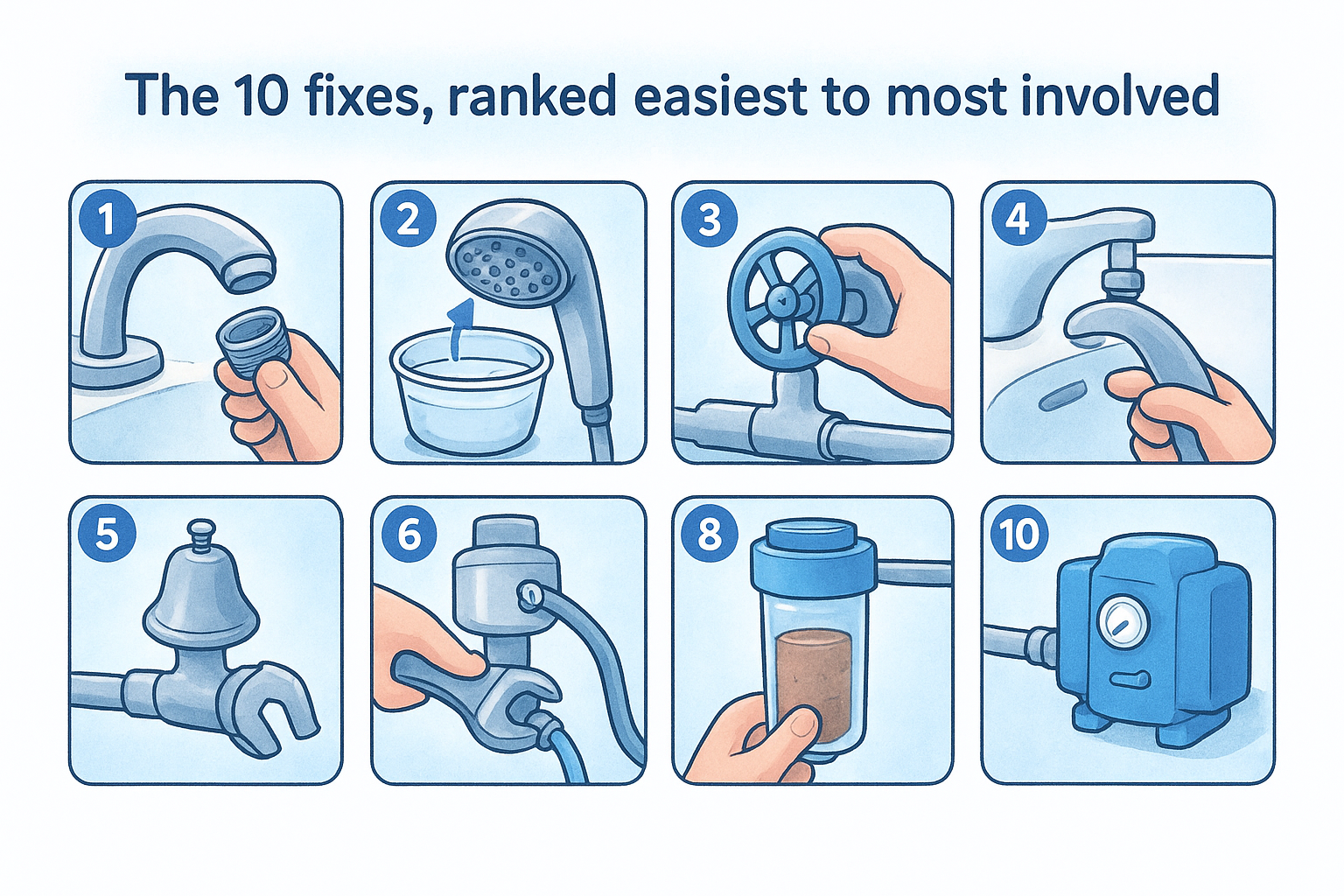
- Clean or replace clogged aerators. Unscrew the aerator from your faucet tip, rinse it under running water, and soak it in white vinegar for 30 minutes to dissolve mineral buildup. Replace it if the screen is torn or crumbling.
- Clean or replace your showerhead. Remove the showerhead, submerge it in white vinegar overnight, then scrub the nozzles with an old toothbrush. A severely clogged showerhead is often cheaper to replace outright than to clean.
- Open your main shutoff valve fully. Find the main shutoff near your water meter, usually in a utility room or crawl space, and turn it counterclockwise until it stops moving.
- Open individual fixture shutoff valves. Check the valves under each sink and behind each toilet. Even a slightly closed valve will choke flow to that fixture alone.
- Adjust your pressure regulator (PRV). Find the bell-shaped PRV on your main supply line, loosen the locknut, and turn the adjustment screw clockwise in small increments to raise pressure. Check your gauge after each adjustment.
- Replace a failing PRV. If adjustment has no effect, the PRV itself may have failed. Replacement kits are available at most hardware stores and install with basic wrenches.
- Flush sediment from your water heater. Connect a garden hose to the drain valve at the bottom of the tank, run it to a floor drain or outside, and let it drain until the water runs clear.
- Check and clean your whole-house filter. A clogged inline sediment filter cartridge can cut pressure across every fixture at once. Replace the cartridge if it looks brown or compacted.
- Remove flow restrictors. Many faucets and showerheads include a small plastic disc inside the fitting designed to limit flow. Pulling it out increases output immediately.
- Install a water pressure booster pump. If your street supply pressure is genuinely low, a booster pump installs on your main supply line and raises pressure throughout the entire house.
Adjusting your PRV is often the single highest-impact DIY fix available, but always recheck your pressure gauge after each small turn to avoid pushing beyond 80 psi and stressing your pipes.
Step 3. Fixes that usually need a plumber
Some pressure problems go beyond what you can safely handle with basic tools. Knowing your limits saves you from turning a manageable repair into an expensive emergency, and in certain cases, local codes require a licensed plumber to complete the work legally. If your testing points to any of the situations below, call a professional rather than attempt the repair yourself.
Corroded or undersized supply pipes
Older homes in the Knoxville area, particularly those built before the 1980s, often have galvanized steel supply pipes that corrode from the inside out over decades. As rust and mineral deposits accumulate, the effective diameter of the pipe shrinks, which chokes flow to every fixture in the house. No amount of aerator cleaning or PRV adjustment will fix this, because the restriction is inside the pipe walls themselves.
If your home has galvanized piping and pressure has declined steadily over several years, a licensed plumber needs to assess how much of the system requires repiping. This typically involves replacing galvanized sections with copper or PEX pipe, which restores full flow and eliminates the ongoing rust problem at the same time. It is a larger project, but it is the only fix that actually solves the root cause.
Repiping sounds expensive, and it is a real investment, but living with corroded pipes often leads to pinhole leaks and water damage that costs far more to repair later.
Main line problems between the meter and your house
The supply line running from the city water meter to your home is your responsibility as the homeowner, not the utility’s. If this line has a partial blockage, a slow leak, or has corroded enough to restrict flow, you will see low pressure throughout the entire house with no obvious fixture-level explanation. A plumber can use pressure testing and camera inspection to locate the problem without tearing up your yard unnecessarily.
Watch for these warning signs that the main line is the source of your problem:
- Pressure is low at every fixture, including outdoor hose bibs
- Your PRV and main shutoff are fully open and functioning
- Pressure at the meter reads fine but drops sharply inside the house
Water heater repairs tied to code requirements
Certain water heater repairs and installations require a permit and inspection in Tennessee, particularly when the work involves modifying supply lines, adding an expansion tank, or replacing the unit entirely. Attempting this work without a permit can create liability issues when you sell your home.
Figuring out how to increase water pressure at home covers a lot of ground you can handle yourself, but these three scenarios are situations where a licensed plumber protects both your plumbing system and your investment in the property.
Quick recap and what to do next
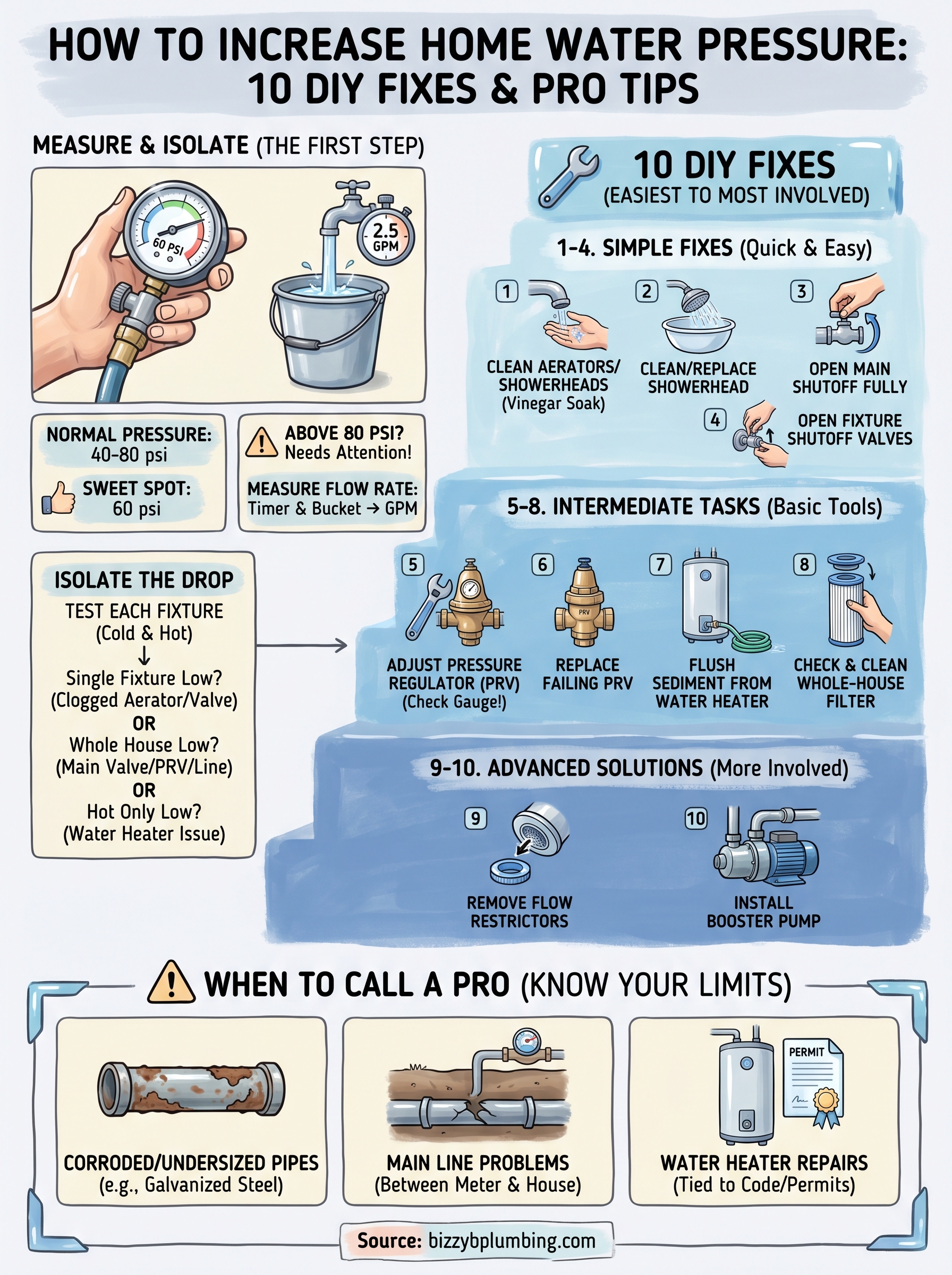
Low water pressure in most homes traces back to a handful of fixable causes. Clogged aerators, partially closed shutoff valves, and a misadjusted PRV account for the majority of cases, and you can clear all three in an afternoon with basic tools. Learning how to increase water pressure at home comes down to measuring first, isolating the location of the drop second, and then applying the right fix rather than working through unrelated repairs.
When your testing points to corroded galvanized pipes, a main line restriction, or a water heater issue tied to permit requirements, those repairs need a licensed plumber. Attempting them without the right tools and experience puts your plumbing system at unnecessary risk.
You do not have to figure this out alone. If you live in Knoxville or East Tennessee and the DIY steps above have not solved the problem, contact Bizzy B Plumbing for same-day diagnostics and straightforward recommendations with no pressure tactics.