
Choosing between a gas vs electric tankless water heater is one of the most common questions we hear from homeowners across Knoxville and East Tennessee. It’s a decision that affects your monthly utility bills, your installation budget, and how reliably hot water reaches every faucet in your house. And there’s no single right answer, the best choice depends on your home’s setup, your hot water demand, and what you’re willing to spend upfront versus over time.
At Bizzy B Plumbing, we install and service both gas and electric tankless units throughout Knoxville, Maryville, Farragut, and surrounding communities. We’ve seen firsthand how the wrong pick can lead to frustration, and how the right one can cut energy costs significantly. This guide breaks down the real pros, cons, and costs of each type so you can make a confident decision before your old water heater forces the issue.
Why the gas vs electric choice matters
Most homeowners focus on the price tag of the unit itself, but that’s only part of the picture. The gas vs electric tankless water heater decision shapes nearly every aspect of your experience, from how reliably hot water reaches every tap to what you pay each month for the next decade. Getting this choice wrong means either an undersized system that can’t keep up with your household, or an overbuilt installation that costs more than it needs to.
Your home’s existing infrastructure
Your house already tells you a lot about which direction to go. If you have a natural gas line already running to your home, you’re in a good position to go the gas route without major infrastructure work. If your home runs entirely on electricity and has no gas connection, adding one involves permitting, line installation, and additional labor cost that may tip the scales toward an electric unit instead.
The infrastructure already in your home is often the single biggest factor in deciding which tankless water heater makes sense for your situation.
Venting requirements are another consideration that differs sharply between the two. Gas units produce combustion gases that need to be exhausted outside, which means your installer routes flue pipes through walls or ceilings. Electric units produce no combustion byproducts, so they require no venting at all, just a proper electrical connection with enough amperage to handle the load.
The real impact on your budget
This decision affects two separate budgets: what you spend now to get the system installed, and what you spend every month to run it. Gas units typically cost more upfront and require more complex installation, but natural gas tends to be cheaper than electricity per unit of energy across most of Tennessee. Electric units are simpler and less expensive to install, but your monthly operating cost depends heavily on local electricity rates and how much hot water your household actually uses.
Neither type is automatically the cheaper option over time. Your usage patterns, your local utility rates, and your starting infrastructure all factor into the math, which is why it’s worth thinking through both sides before you commit.
How gas and electric tankless heaters differ
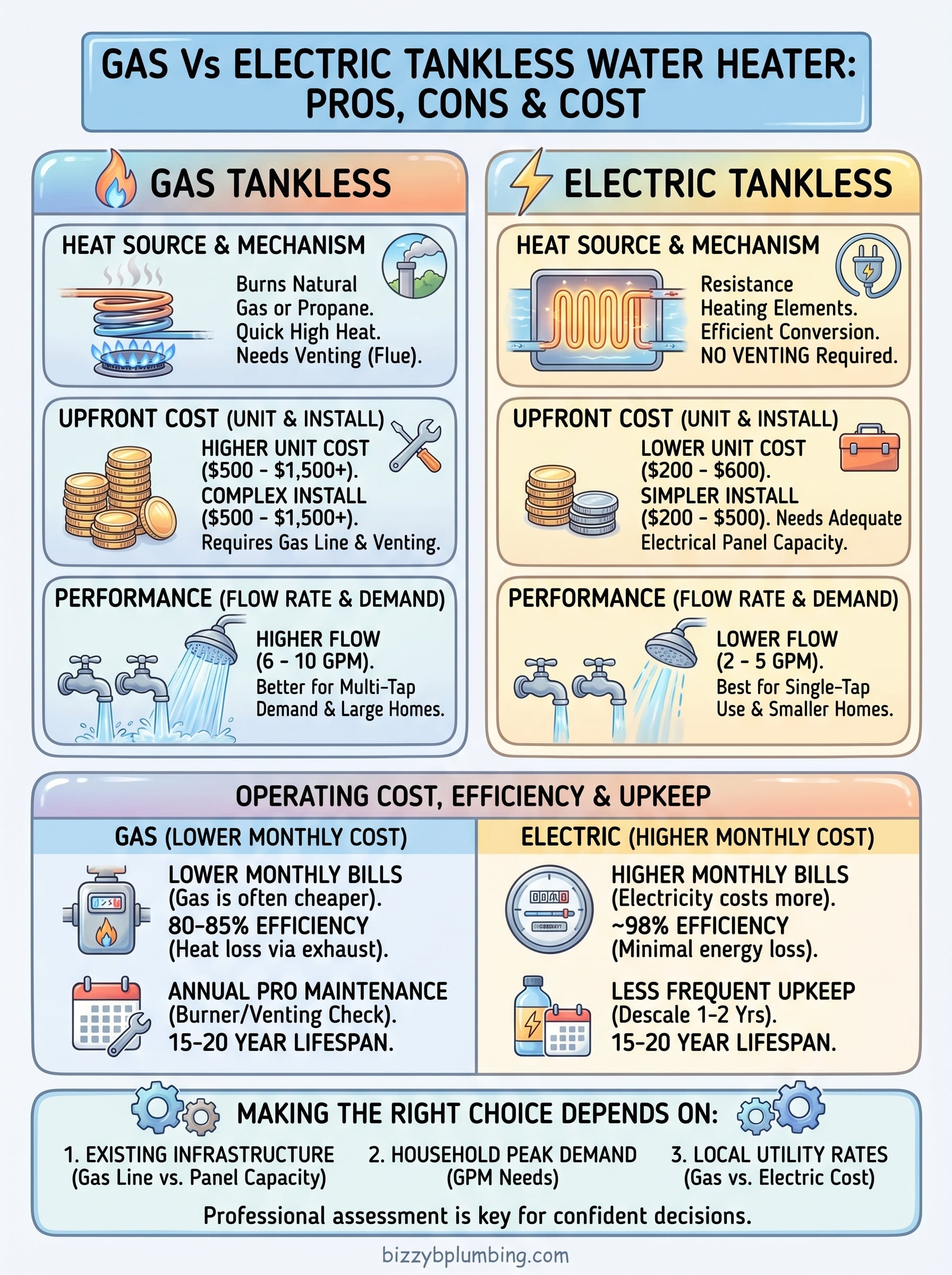
At the core, the gas vs electric tankless water heater decision comes down to the heat source. Gas units burn natural gas or propane to heat water through a burner assembly, while electric units run cold water across a set of resistance heating elements powered by your home’s electrical panel. Both approaches heat water on demand with no storage tank, but the mechanics, requirements, and outputs differ significantly.
How each type heats water
Gas units ignite a burner when you turn on a hot water tap, pushing water across a heat exchanger that rapidly raises the temperature before it reaches your faucet. The combustion process generates high heat output quickly, which gives gas units an edge when multiple taps or appliances demand hot water at the same time. Because gas burns at higher temperatures than electrical resistance elements can reach, gas units can heat larger volumes of water faster.
Electric units work differently, passing water through a chamber where resistance heating elements transfer heat directly to the water. The process is efficient in terms of energy conversion because nearly all electrical energy converts to heat with minimal loss.
Electric tankless heaters convert close to 98% of their energy input into usable heat, making them highly efficient at the point of use.
Maintenance and lifespan
Gas units require annual maintenance, including burner inspection, venting checks, and heat exchanger cleaning. Electric models need less routine servicing, though you should still descale the heating elements in hard water areas every one to two years to keep performance consistent.
Upfront cost and installation requirements
When comparing a gas vs electric tankless water heater, the upfront cost gap is real and worth understanding before you call a plumber. Electric units typically run between $200 and $600 for the unit alone, while gas models range from $500 to $1,500 or more depending on flow rate and brand.
Unit purchase price
Electric units cost less off the shelf, but the full picture includes more than the sticker price. Your household’s hot water demand determines what size unit you need, and a larger electric model closes the price gap with smaller gas units quickly. Gas units at higher flow rates command premium prices, but they handle multi-tap demand that smaller electric units can struggle to keep up with.
Installation labor and extras
Labor costs separate the two types significantly. Electric installation typically runs $200 to $500 when your panel has enough capacity, since no venting is required and the job is straightforward for a qualified plumber. Gas installation is more involved, often ranging from $500 to $1,500 in labor alone, depending on whether venting needs to be routed through walls and whether your gas line requires an extension or upgrade.
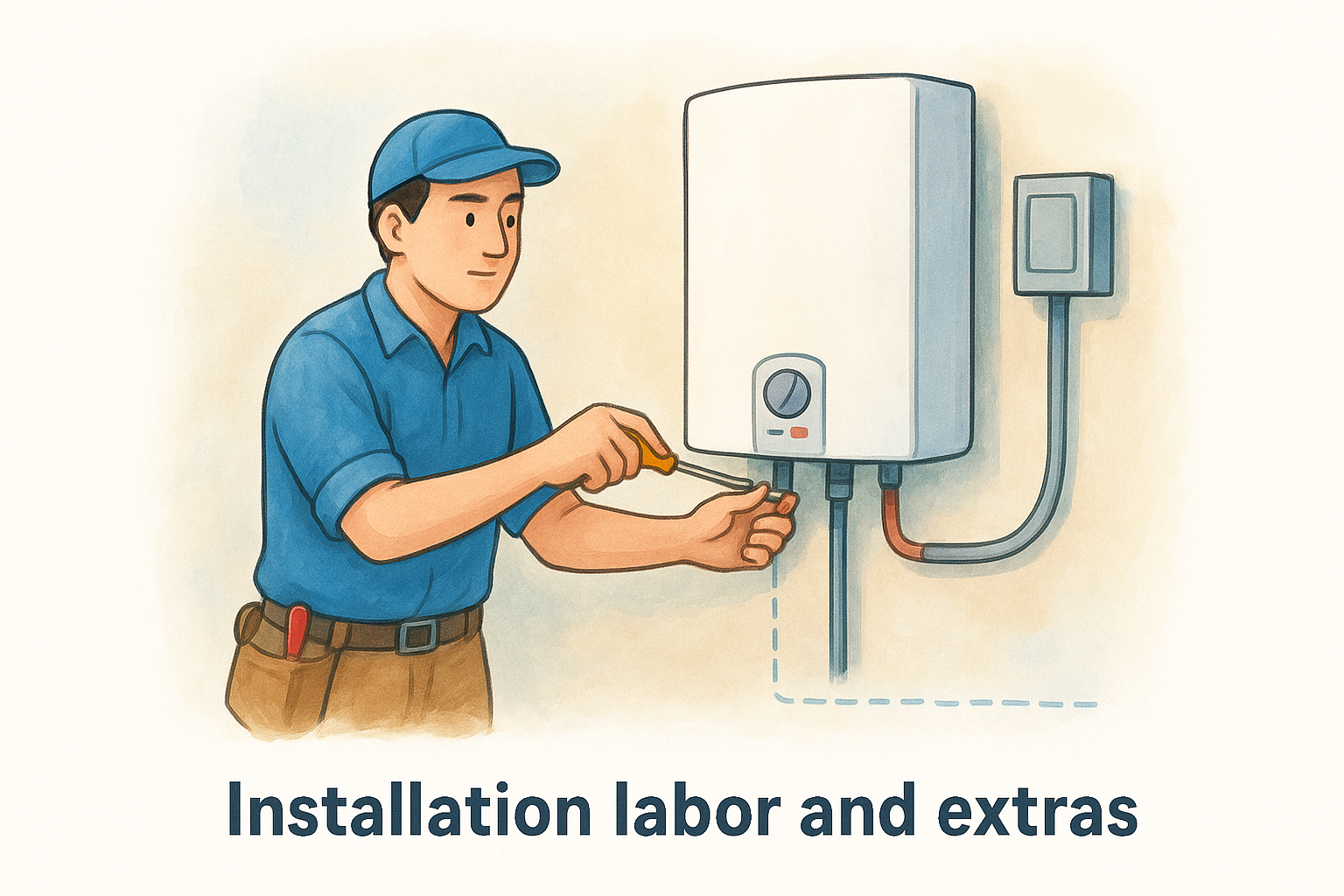
If your home lacks an existing gas line, adding one can tack on $500 to $2,000 or more to your total project cost before the heater even goes on the wall.
Permits are required for both types in most jurisdictions, so build $50 to $200 in permit fees into your budget based on your local municipality’s requirements.
Performance and sizing for your household
When comparing a gas vs electric tankless water heater, performance comes down to one number: flow rate, measured in gallons per minute (GPM). A unit with too low a flow rate struggles when you run the dishwasher while someone showers, leaving you with lukewarm water at both ends. Knowing your household’s peak demand before you buy is the step most homeowners skip, and it’s the one that causes the most frustration later.
Flow rate and household demand
Electric tankless units typically deliver 2 to 5 GPM, which works for smaller households or single-bathroom applications. Gas units reach 6 to 10 GPM, making them better suited for larger homes where multiple fixtures run at the same time.
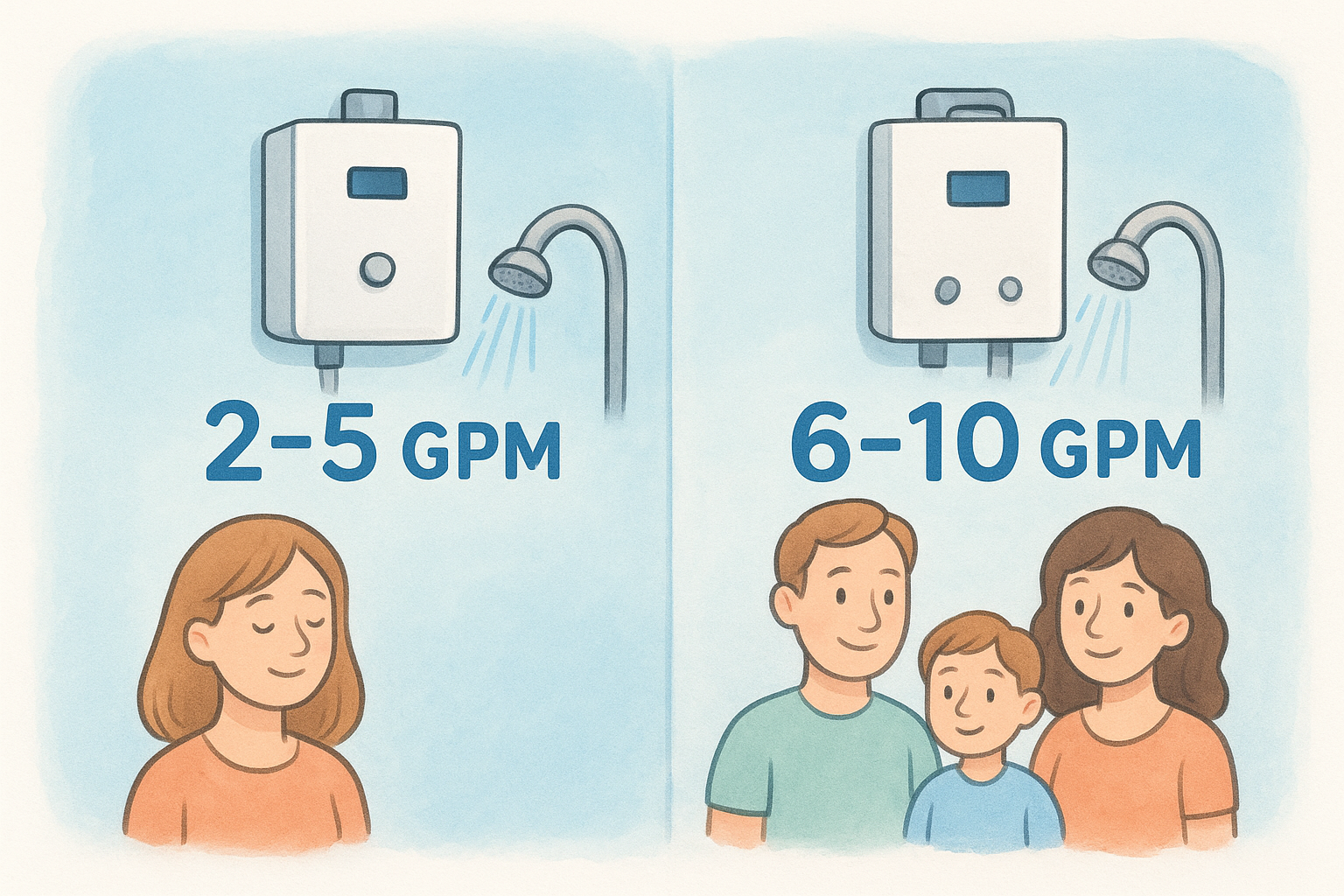
A family of four with two full bathrooms, a dishwasher, and a washing machine will find a gas unit significantly more capable of keeping up with simultaneous demand. Under sizing is the most common mistake homeowners make when switching to tankless, and it’s one that costs money to fix after the fact.
Sizing your unit to your actual peak demand, not just average use, is what separates a system that works from one that frustrates you daily.
Temperature rise and climate impact
Your incoming water temperature affects performance more than most people expect. In East Tennessee, groundwater temperatures drop noticeably in winter, which means your unit has to work harder to reach your target output temperature. Gas units handle this more easily because their higher heat output compensates for the larger temperature difference during cold months.
Operating cost, efficiency, and upkeep
Running costs separate the gas vs electric tankless water heater debate more than almost any other factor. Electric units convert close to 98% of input energy into heat, while gas units typically land between 80% and 85% efficiency due to heat lost through the exhaust flue. Higher efficiency sounds like a clear win for electric, but your actual monthly bill depends on what your utility charges per unit of energy, not just conversion rates.
Monthly energy bills
Natural gas tends to cost less per BTU than electricity in most parts of Tennessee, which means a less efficient gas unit can still produce cheaper hot water month to month. Your specific utility rates from Tennessee Valley Authority and your local gas provider determine which type costs you less over time. Run the numbers using your current bills before you decide.
In most Tennessee households, gas units deliver lower monthly operating costs despite their lower efficiency ratings, simply because natural gas remains cheaper per unit of energy than electricity.
Routine maintenance
Gas units need annual professional service to inspect the burner, clean the heat exchanger, and verify that venting stays clear and safe. Electric units require less frequent attention, but descaling the heating elements every one to two years keeps performance consistent, especially in areas with hard water. Skipping maintenance on either type shortens the unit’s lifespan, which typically runs 15 to 20 years for both when serviced properly.
Next steps for your home
The gas vs electric tankless water heater decision gets clearer once you know your home’s existing infrastructure, your household’s peak hot water demand, and what your utility rates actually are. Those three factors tell you more than any product spec sheet, and they point you toward the option that fits your situation rather than the one with the best marketing.
Before you buy anything, have a licensed plumber assess your gas line access, electrical panel capacity, and venting options. That inspection saves you from committing to a unit your home can’t support without expensive upgrades. If you’re ready to move forward, contact Bizzy B Plumbing for a straight answer on which type works best for your Knoxville or East Tennessee home, along with upfront pricing and same-day availability to get your hot water running the way it should.